“Can we steal from what serial television does and apply it to learning? Absolutely.”

Hadiya Nuriddin
CEO of Duets Learning
Unlock the secrets to truly engaging learning experiences with insights from Hadiya Nuriddin, MA, MEd. Discover practical strategies that keep learners invested, motivated, and coming back for more.

Making training impossible to ignore is the dream. Yet, one of the biggest challenges in instructional design is keeping learners engaged. People might sign up for a course or start an e-learning module — but how do you keep them interested enough to continue?
Many are struggling to crack the code. But, the award-winning instructional designer, international keynote speaker, author, and CEO behind Duets Learning knows better and goes beyond the basics. In a recent We Are webinar, expert Hadiya Nuriddin, shared 3 strategies to captivate and motivate learners:
Catch up on the full session here. And here’s a summary of how these 3 learning engagement strategies can turn training from a passive experience into something learners want to be part of.
Think about what keeps you hooked on a great TV series. It’s not just the information. It’s the suspense, the structure, and the feeling that you need to know what happens next.
“Can we steal from what serial television does and apply it to learning? Absolutely.”
That’s the idea behind episodic learning: instead of presenting everything at once, break training into smaller, connected lessons that unfold over time.
To apply episodic learning in instructional design, consider these best practices as described by Hadiya:
Each module should naturally lead into the next.
End sections with a challenge, an open question, or a problem to solve next time.
When training content is designed like an unfolding story, learners want to return because they’re invested in what happens next.
“A rhetorical appeal is a persuasive strategy used in communication to inform the public by targeting their emotions, their logic, and their ethics,” describes Hadiya.
How information is framed can make the difference between a forgettable lesson and a powerful one. Hadiya explains that rhetorical appeals enhance engagement because they help learners see the relevance of their learning.
3 rhetorical appeals for instructional design
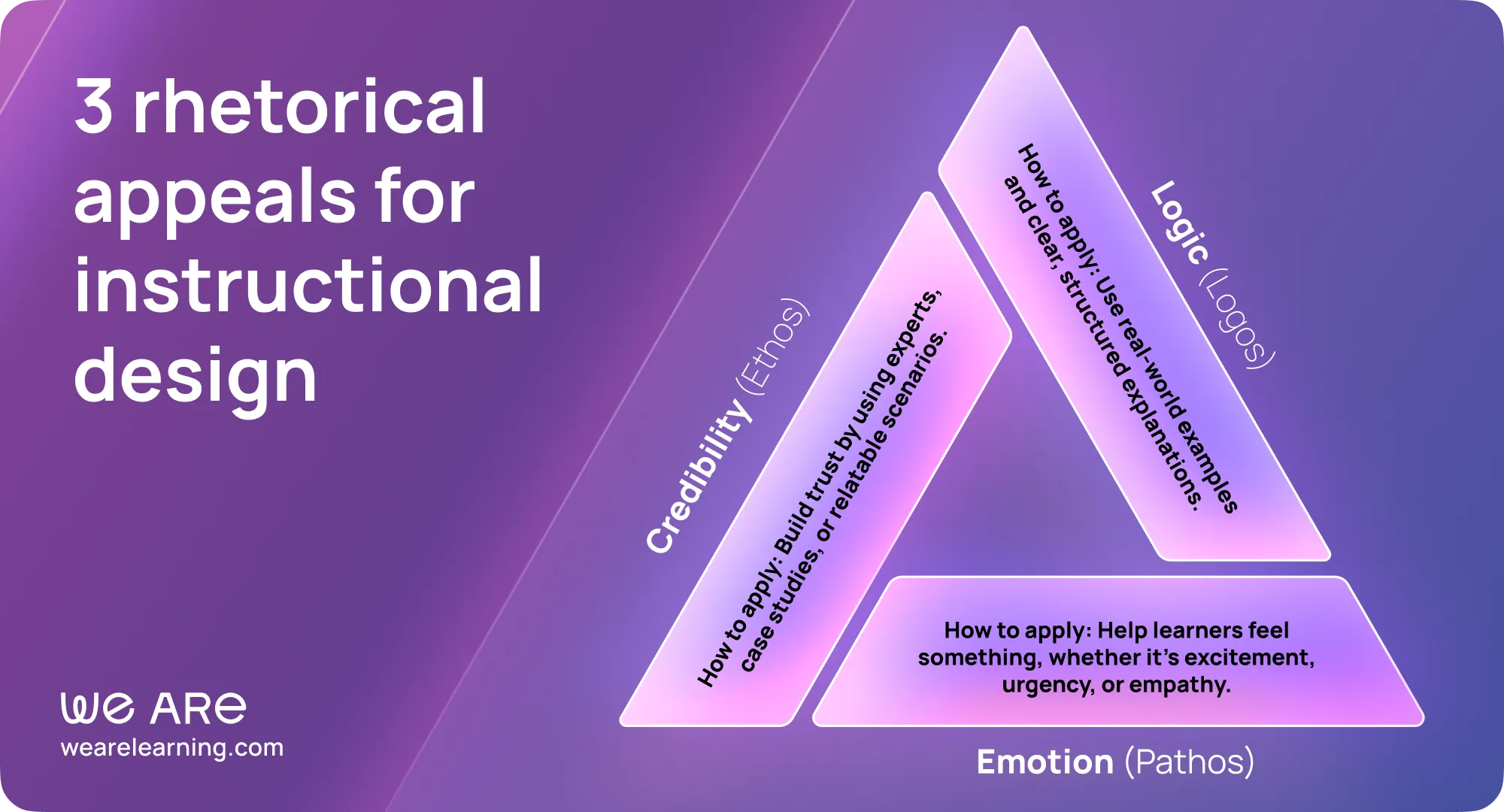
By using rhetorical techniques, instructional designers can create more engaging corporate training that sticks with learners long after the course ends.
Scenario-based learning transforms training from passive consumption into active decision-making.
“I want learners to feel like, ‘I lived that experience already. It’s easier for me to take it back on the job.’”
For example, see this We Are Story that puts learners in a high-pressure leadership situation where they have to give timely feedback:
Instead of just reading about a topic, learners make choices, solve problems, and see the impact of their decisions.
Want to create your own scenario-based learning content? Start for free with We Are and build your first interactive Story today.
As described by Hadiya, “the best thing you can do for a scenario… is to create a situation where people recognize themselves and the people they're seeing on the screen. That's not Samantha going through that. That's me going through that.”
This approach keeps learners engaged while building confidence in real-world problem-solving.
Hadiya is the CEO and Chief Learning Strategist at Duets Learning, a learning and development consultancy in Chicago. She is an award-winning talent development professional with over 20 years of experience in the field, she helps clients create effective, engaging, and interactive learning solutions that support their organizational goals and needs.
Watch the full We Are webinar featuring Hadiya diving into learning engagement strategies.
Create learning that is anything but boring
Roleplay
Branching scenarios
3D characters
Upload PPT, PDF, DOCs
Quizzes
Hotspots
SOC2
Multiple languages
Branding and customization
AI video
SCORM
LMS
URL
Embed
Image to video
Talking avatars
Prompt AI assistant
Write your script